Lasers for Undergraduate Labs HEXA-BEAM Laser
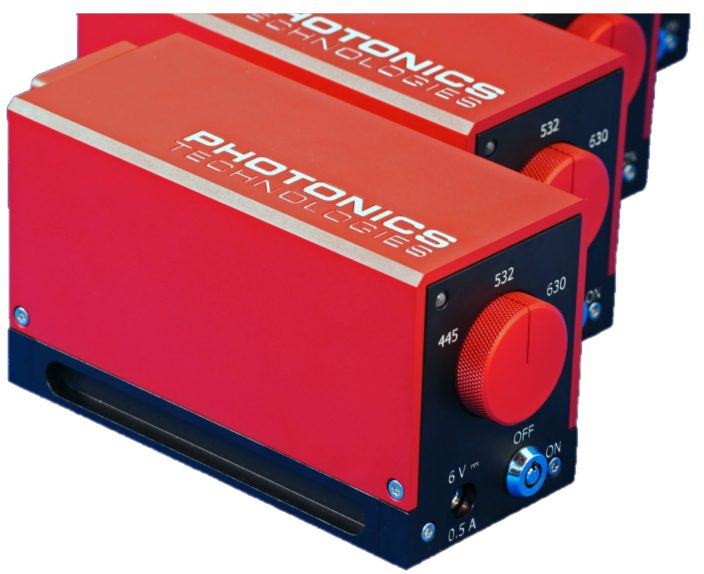


The Hexa-Beam Laser is designed to switch between up to six different wavelengths without the need to realign the equipment and this is done by rotating a single dial.
Rotating the initial polarisation of the light changes the position of the maxima and minima within the sugar solution, as seen in this video.
This allows for the physics experiment to be conducted at different wavelengths, whilst ensuring that other critical variables remain controlled. The different wavelengths are emitted along the same optical path and are vertically polarised.
The HEXA-BEAM Laser contains as standard the 405nm, 520nm, and 650nm modules. Up to a total of six wavelengths can be included upon request.
PHYSICS EXPERIMENTS
The ease of set-up and use makes the HEXA-BEAM Laser a fantastic tool for a number of physics experiments. We have conducted physics experiments and developed lab scripts that will be provided for use to lab technicians and students in the undergraduate labs together with the Hexa-Beam Laser:
Experiment Descriptions:
Measuring the Wavelength of Light using a Diffraction Grating
This experiment is ideal for physics students from Key Stage 3 upwards, providing a visible demonstration of the effect of the wavelength of light on the diffraction patterns produced. This is a required practical for A-level Physics.
Measuring the Wavelength of Light using a Steel Ruler
A fun alternative method to determine the wavelength of light, using a piece of simple equipment – a steel ruler – to act as a diffraction grating. This experiment is perfect as an introductory optics experiment for undergraduate students, or for providing a comparison to the traditional method of ‘Measuring the Wavelength of Light using a Diffraction Grating’.
Young’s Double Slit
Investigate the wave and particle nature of light by investigating the interference pattern formed by a double slit in this experiment, which provides evidence for the fundamentally probabilistic nature of quantum mechanics. Young’s Double Slit is an essential topic in both A-level and undergraduate courses.
The Faraday Effect in Chiral Material
This experiment describes the rotation of the plane of polarisation of linearly polarised light, due to a magnetic field. In addition to our lab script, this experiment has been conducted with Durham University. This experiment is ideal for undergraduate optics laboratory classes, linking to Light and Matter, and Magnetism modules.
Rotating the Plane of Polarisation Through Sugar Solutions (also known as Biot’s Optical Rotation Experiment)
Learn about the physical of light scattering, polarisation, chiral chemistry and fluorescence in this simple experiment. This experiment has been demonstrated by Durham University in detail and is suitable for more advanced undergraduate modules or as a super-curricular activity for academic enhancement at school.

“The advantage of using the HEXA-BEAM lasers is—depending on the modules installed— up to six wavelengths may be studied using a single device, without the need for realignment.”
Ref: Measuring the Faraday effect in olive oil using permanent magnets and Malus’ law,
Daniel L Carr, Nicholas L R Spong, Ifan G Hughes and Charles S Adams,
Published 13 January 2020 • © 2020 European Physical Society
Factfile
| Classification | Class 2 |
| Output power | <1 mW |
| Beam diameter (1/e^2) | 2mm |
| Dimensions | 150mm x 70mm x 87mm |
| Power supply | 6 V DC (supplied) |
Applications
Demonstrating laws of physics such as:
- Measuring the Wavelength of Light using a Diffraction Grating
- The Faraday Effect in Chiral Material
- Rotating the Plane of Polarisation Through Sugar Solutions
- Measuring the Wavelength of Light using a Steel Ruler
- Young’s Double Slit
Options
Up to six laser modules can be included in the new HEXA-BEAM Laser, allowing the selection of different wavelengths by simply turning the easily operational knob. The different wavelengths are emitted along the same optical path and are vertically polarised.
Available wavelengths:
Standard
405nm 520nm 650nm
Additional optional visible wavelengths
445nm 532nm 635nm 685nm
Additional optional IR wavelengths
(>700 nm for Class 3R specification)
780nm 808nm 830nm 850nm 940nm 980nm
Deliveries
4-6 Weeks
Request A Demo
Demonstrations can be arranged. Please get in touch on our contact us page to find out more information.